Top 8 Precision Metal Stamping Standards How Engineering Optimization Saves 25% on OEM Parts Costs
Introduction
During the quest for Engineering Quality Management, OEM engineers often face an expensive problem – the need for advanced metal stamping design is often accompanied by low yield and high costs. The reason for such a situation may not be related to the use of the appropriate press machine. Rather, the cause is that there is no profound harmony between design and production, and there is no consideration of the physical limitations associated with stamping at the stage of designing.
The following paper reviews Production Process Optimization strategies employed by eight major international suppliers. Based on the analysis of technical standard compliance practices, we offer a practical approach to precision metal stamping engineering. Gaining control over these areas helps turn mass production into an asset for OEMs and bring about 25% cost reduction.
Why Should Protolabs and Fictiv be the Benchmark for Design for Stamping?
The digital manufacturing firms Protolabs and Fictiv have raised the bar in transforming prototypes into products by doing away with conventional stamping machinery. What makes them great in their own right is their ability to leverage DFM algorithms to deliver instant feedback about whether a particular design violates the principles of manufacturability. For example, they will alert you to any insufficient bend radius or tight tolerance. By doing so, they set the benchmark for design for stamping manufacturing.
- Rapid DFM Validation for Risk Reduction: The key to success in using Protolabs and Fictiv services lies in the fact that they allow users to quickly get manufacturability feedback. All it takes is to upload a CAD file into the application, which will immediately generate a report about what issues there might be with the model. Some examples include the presence of sharp inner angles that would cause tearing or an unbalanced form that will result in a mis-hit.
- Bridging the Design Engineering Knowledge Gap: Not all OEM teams have much experience with stamping technology. Protolabs and Fictiv are digital bridges that translate the designer’s intent into stampable shapes. The software forces the application of basic stamping principles, teaching the OEM team about grain orientation, clearance between holes and edges, and the need for symmetry in order to ensure stable manufacturing. This helps establish stamping design optimization literacy.
- Limitations and Strategic Value: Actually the point of these services is to lead the way rather than be the final goal. Sure, software is great for small-scale rapid prototyping and the initial phases of design optimization. Yet, the level of detail required for the manufacturing of automotive or aerospace components that are going to be stamped billions of times may well be beyond their capabilities. In fact the main role of the services is to take the risk out of the design process, most of the time they send optimized parts to be manufactured in high volumes by specialists.
How Does Xometry and Hubs Enforce Compliance with Technical Standards Within Global Networks?
Xometry and Hubs have built enormous global manufacturing networks. The trick in all this is that they maintain compliance with technical standard compliance within these heterogenous networks. They do this not by imposing standard procedures, but by enforcing a strict system of digital quality control standards on every single order. It means that whatever gets manufactured at any given factory is guaranteed to match the required manufacturing accuracy assurance standards.
1. Standardization Through Digital Process Control
The secret to their success is in the separation of specification and process. All orders are subjected to a digital system of standardized production processes. The engine tells you precisely which materials certificates, inspection process SPC, CMM, and other requirements your order needs. This is the process control that is then executed on-site and reported back through the network.
2. Auditing and Supplier Tiering for Compliance
Not all nodes within their network are considered equally important. Xometry and Hubs have an internal ranking system for suppliers based on their previous performance according to the Quality Control Standards. Suppliers that are able to manufacture parts with high precision and offer total material traceability are ranked higher and entrusted with more difficult jobs. The result is a highly competitive environment in which Technical Standard Compliance is positively incentivized through business.
3. The Problem with Process Optimization at Scale
As far as manufacturing of standard parts is concerned in the main these services are quite adequate. But as the features of the parts become more demanding with, for example, custom die design or engineering, the network is not able to efficiently produce these pieces due to the lack of face-to-face interaction. Besides although they have the capacity to produce an extensive range of components physically, they Yes lack the expertise and know-how that are the prerequisites for trying some of the latest innovations.
Is the Engineering Quality Management at Jabil the Best Practice of OEM Metal Stamping Service?
The engineering quality management practices of Jabil can be viewed as the epitome of vertical integration and scale in the realm of contract manufacturing. These OEM metal stamping services have their roots in the holistic concept of an engineering quality management process ranging from material science through final assembly. The McKinsey Industry 4.0 trends report indicates that this kind of vertical integration is required to cope with complexity and reduce time to market when working at maximum possible volume.
1. System Engineering Approach to Stamping
The stamping process at Jabil does not exist as an isolated stage but as one of interconnected nodes in their vertically integrated manufacturing processes. Their OEM metal stamping service involves not only design and production of tools for stamping but also mold design and optimization for assembly lines in order to achieve the necessary Production Process Optimization.
2. Statistical Process Control (SPC)
Drawing upon their electronics manufacturing background, Jabil uses SPC to achieve zero defects. All presses are equipped with sensors, measuring tonnage, vibration, and cycle time. This information is collected and analyzed, allowing for predictive maintenance and immediate action, resulting in a defect rate approaching zero while maintaining an uninterrupted supply chain.
3. The Benefits and Drawbacks of Scale
The massive size of Jabil’s operations offers certain strengths in terms of supply chain resilience and material price negotiations. On the other hand, such scale could negatively impact responsiveness to extremely small volumes and revolutionary designs. Jabil is the perfect choice for mature products with a high volume and a critical need for Engineering Quality Management.
Why Is Specialized Precision Metal Stamping Engineering Superior to General Digital Platforms?
Though digital platforms may have advantages in terms of access and speed, the specialized precision metal stamping engineering services offer more. These experts are equipped with tribal knowledge about how metal works, die physics, and the issues faced by mass production that cannot be fully captured by any digital program. It is only through their extensive expertise that the parts they work on will not only perform but outperform in terms of reliability, economy, and efficiency.
1. The Importance of Strain Analysis and Simulation
Not only can specialists go beyond basic design for manufacturing checks; they can use advanced techniques in finite element analysis (FEA) to analyze the potential for cracking, wrinkling, or inconsistent forming while still doing the stamping engineering service. In addressing more difficult forming concerns, top precision stampings manufacturers utilize strain analysis to ensure that the resulting component is physically stable.
2. Proprietary Die Technology and Process Tuning
The key to precision metal stamping engineering is the die. Engineering specialists make use of elaborate multiple stage progressive dies and advanced die coatings that allow longevity and accuracy over millions of cycles. In addition, they become experts at “process tuning” whereby they adjust pressing speed, lubrication, and shut height to produce results which generalists simply can’t achieve.
3. Long-Term Partnerships and Continuous Improvement
In contrast to mere transactions with the platform, the engineering specialist develops long-term partnerships with the Original Equipment Manufacturer (OEM). Through such partnerships, the specialists help their customers improve the engineering service provided by engaging in value engineering activities including material changes and design changes.
Does Optimizing Advanced Production Processes Help in Minimizing Waste in Bulk Manufacturing?
In bulk stamping operations, material cost is by far the greatest factor of the expenses incurred. Thus, an advanced optimization of material usage in production process is a direct way to reduce costs in large numbers. With the help of optimized strip layout and scrap reduction techniques, one can save up to 15%, thus increasing the profit margin without breaching the strict rules of Industrial Manufacturing Specifications.
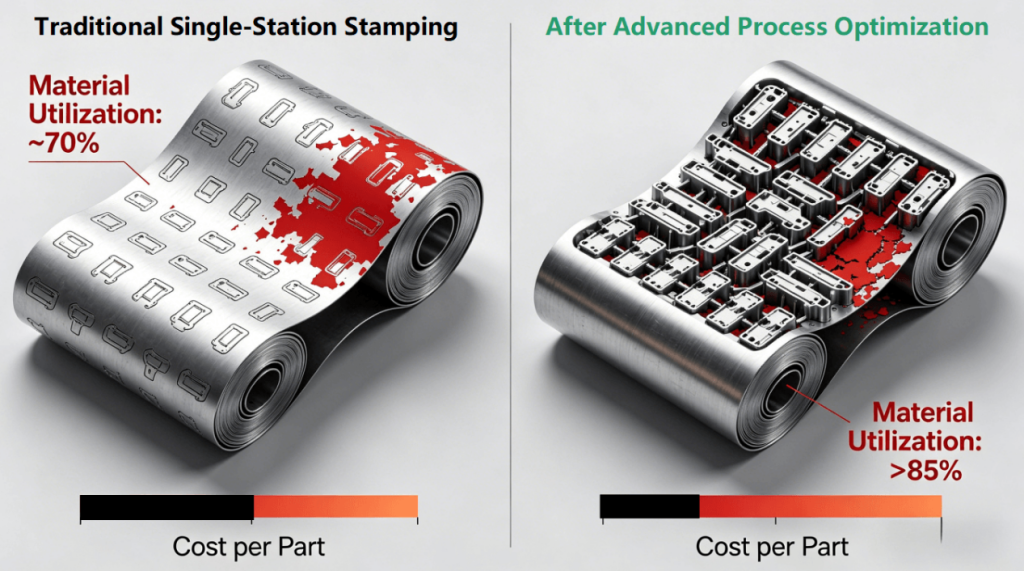
- Virtual Strip Layout and Nesting Techniques: First, let us consider the optimization of strip layout via virtual nesting. With the help of special software, engineers can perform multiple simulations of layouts to increase the quantity of the parts per strip. The optimization will consist in finding the most effective position of the part on the strip as well as determining its width.
- Multi-Slide and Transfer Die Approaches: In complex designs, there is an entirely new approach to how the materials are handled using multi-slide presses and transfer dies. In comparison to the use of conventional single station dies, which produce substantial skeleton scrap, these approaches allow engineers to incorporate parts interleave and multiple operations (pierce, form, coin) in one die, decreasing the proportion of scrap. This degree of Production Process Optimization necessitates a lot of engineering effort; however, it will definitely pay off massively.
- The Connection Between GD&T and Material Optimization: While optimizing materials used in manufacturing processes, it is vital not to undermine the performance of the part itself. That’s why the ASME Y14.5 standard becomes relevant here. Properly identifying datum structures and geometric tolerance (true position and profile, for example), will enable justifying tighter nests and adhering to Industrial Manufacturing Specifications.
How does LS integrate AS9100DExcellence into Precision OEM Stamping Service?
Manufacturing Excellence in precision stamping is not only about having high-end press equipment. It is more about developing a quality culture across all processes. This includes integrating high-quality standards such as AS9100Din aerospace industries and IATF 16949in automotive industries with precision OEM stamping services. With this process, every part is manufactured without defects, and there will be strict adherence to regulations.
1. Process-Oriented Quality Management Systems
The first approach to manufacturing excellence is the process-oriented QMS. Rather than seeing quality as something to check at the end of production, it becomes integrated into the process itself. In the case of precision OEM stamping services, process parameter control must be established for every critical feature (force, temperature, etc.) and monitored constantly. Any deviation leads to corrective measures immediately.
2. Complete Digital Traceability and Accountability
Both AS9100D and IATF 16949 make it necessary to have full traceability. This allows tracking all metal stamping fabrication lots to their coil of material, die set, and machine operator. This digital trail will enable the investigation of any problem with parts on the field and serves as the basis of technical compliance standardization.
3. Continuous Improvement via Data Analytics
The ultimate level of integration is the usage of the QMS for continuous improvement. Data collected on the shop floor about scrap rate, machine wear, etc., is analyzed in order to detect the trends in the process performance. Such an analytical approach forms a foundation for kaizen events and process improvement projects in which the precision OEM stamping service becomes even better than before. To achieve ultimate stability for your company’s future projects, cooperation with a custom metal stamping fabrication provider with 100% process monitoring ability is essential.
Conclusion
Engineering Quality Management within the scope of metal stamping is a strategy and not a tactic. Quality management cannot be judged simply based on the weight of tonnage capacity, but rather on the level of metal stamping engineering expertise and the standards set by the Quality Control Standards in play. Through benchmarking against the best precision stampings manufacturers globally, OEMs will see their manufacturing supply chain shift from a drain of costs to a source of competitive edge. There is enough evidence that adopting a comprehensive strategy involving stamping design optimization and Production Process Optimization, driven by Technical Standard Compliance, will help companies reduce hidden manufacturing costs associated with scrap and rework by up to 25%.
FAQs
Q1: How do I validate a precision stampings manufacturer’s Technical Standard Compliance?
A: Look into their portfolio of certifications (ISO 9001, IATF 16949, AS9100D), and ask them to prove compliance with standards through audit reports and process control documentation. According to IAQG Aerospace Quality Management Standards, material traceability and process validation documentation guarantee Manufacturing Accuracy Assurance.
Q2: How does the optimization of stamping designs help cut down OEM costs?
A: Stamping design optimization is the key parameter which will impact tooling lifecycle, scrap and manufacturing uptime. Bad design results in accelerated wear and tear of dies and rejects. As per NIST Smart Manufacturing Guidelines, virtual simulation in the design phase can save time on prototyping and design adjustments later on.
Q3: What are the dangers of neglecting Engineering Quality Management in large-scale manufacturing?
A: Neglecting Engineering Quality Management results in unregulated process variance and disastrous batch losses. In precision OEM stamping services, even small changes in material characteristics can induce dimensional variation. The sole solution to mitigate these threats is through solid Engineering Quality Management systems incorporating SPC and gage R&R studies.
Q4: What benefits does Production Process Optimization offer for material efficiency in metal stamping operations?
A: Production Process Optimization uses scientific nesting programs and multi-station die construction to reduce skeleton wastage. Methods such as common-line cutting and part-to-part nesting can boost material efficiency from an average of 70% to more than 85%.
Q5: Is LS capable of offering stamping engineering service for difficult-to-form materials?
A: Yes. LS has a lot of experience dealing with difficult-to-form metals. With the help of advanced servo press technology and stress relief technique, its stamping engineering service keeps manufacturing accuracy assurance even on the most complicated custom metal stamping projects.
Author Bio
The author is a manufacturing specialist specializing in producing high volume, precision components in industries such as automotive, aerospace, and medical devices. With extensive experience in incorporating complex quality management standards including IATF 16949 and AS9100D into metal stamping processes, the author supports the work at LS Manufacturing – a global company focused on solving difficult manufacturing challenges with the use of engineering-led precision metal stamping engineering solutions.